Explore Rome
Top attractions in Rome
Explore Rome
Rome is one of the world's most captivating destinations, known for its remarkable history, iconic landmarks, and vibrant culture. From ancient monuments to elegant gardens and lively neighborhoods, the city offers unforgettable experiences for every visitor.
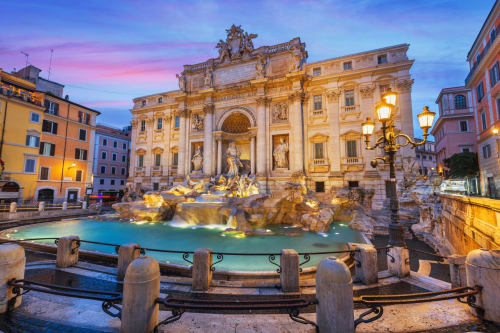
Trevi Fountain
The Trevi Fountain is one of the most important monuments of Rome, but also the most famous fountain in the world. Theme representative of the sculpture is the sea. The scenery is dominated by a chariot in the shape of a shell on which rests a statue of Ocean by Pietro Bracci, flanked by statues of Healthiness and Abundance. The first is a girl, which indicated the water source to the Roman soldiers, but the statue of the aqueduct project approved by Agrippa. The chariot is pulled by sea horses, preceded by massive newts.
Fontana di Trevi
The Trevi Fountain is tied to a legend is said to bring good luck tossing a coin into the fountain turn away, because this will definitely come back to the capital. The coins, collected daily, is destined for charity.
Fontana di Trevi
The Trevi Fountain is tied to a legend is said to bring good luck tossing a coin into the fountain turn away, because this will definitely come back to the capital. The coins, collected daily, is destined for charity.
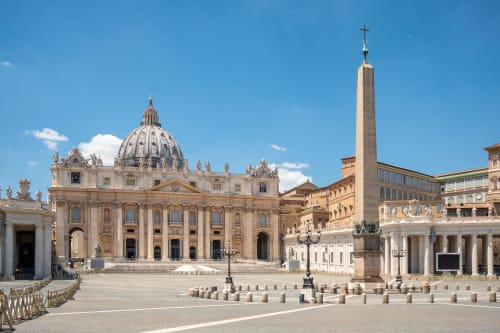
Vatican
The Vatican is the seat of spiritual and institutional Catholicism and the Pope. In the Vatican City are kept more attractive monuments of Rome such as: the Basilica di San Pietro, the Vatican Museums and Castel Sant'Angelo.
The Basilica of St. Peter is the main church. It was built in 1626 during the pontificate of Urban VIII. Contributed to its realization in different eras distinguished architects such as Bramante and Michelangelo. The Catholic tradition has it that St. Peter, one of Jesus'apostles and the first pope of hristianity, had been buried in the same place where the basilica was erected.
Vaticano
Inside the Vatican Museum you can admire the most important art collections in the world. Most of the successive enlargements go back to the eighteenth century, a period in which works of art collected by the popes were exhibited for the first time. Belong to the museums on the Sistine Chapel and Raphael's Rooms.
Castel Sant'Angelo was built by Emperor Hadrian in 135 AD It 'been over the centuries the fortress, home to prisons, until it became a papal residence.
The Basilica of St. Peter is the main church. It was built in 1626 during the pontificate of Urban VIII. Contributed to its realization in different eras distinguished architects such as Bramante and Michelangelo. The Catholic tradition has it that St. Peter, one of Jesus'apostles and the first pope of hristianity, had been buried in the same place where the basilica was erected.
Vaticano
Inside the Vatican Museum you can admire the most important art collections in the world. Most of the successive enlargements go back to the eighteenth century, a period in which works of art collected by the popes were exhibited for the first time. Belong to the museums on the Sistine Chapel and Raphael's Rooms.
Castel Sant'Angelo was built by Emperor Hadrian in 135 AD It 'been over the centuries the fortress, home to prisons, until it became a papal residence.
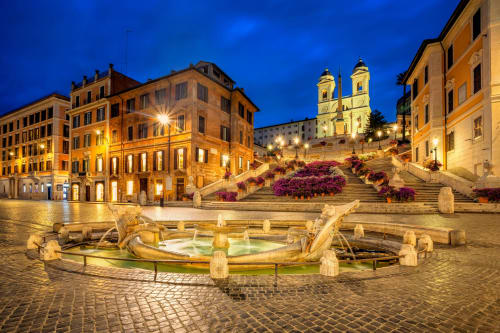
Piazza di Spagna
"Piazza di Spagna", through the steps of Trinita dei Monti, one of the most famous squares of Rome. At its center is located Barcaccia Fountain by Pietro Bernini, Gian Lorenzo Bernini. At right is the home of English poet John Keats, now a museum in his honor. On the left hand you can visit the dining Tearoom. Towards Via Frattina stands the Palace of Propaganda Fide.
The impressive staircase of 135 steps, was inaugurated by Pope Benedict XIII on the occasion of the Jubilee of 1725. Its construction was built to connect the Spanish embassy to the church of Trinita dei Monti. The staircase was designed so that approaching the stage effects were increasing gradually. Typical of the great Baroque architecture was in fact the creation of long, deep perspectives culminating with the fifth or backgrounds monumental character.
The impressive staircase of 135 steps, was inaugurated by Pope Benedict XIII on the occasion of the Jubilee of 1725. Its construction was built to connect the Spanish embassy to the church of Trinita dei Monti. The staircase was designed so that approaching the stage effects were increasing gradually. Typical of the great Baroque architecture was in fact the creation of long, deep perspectives culminating with the fifth or backgrounds monumental character.
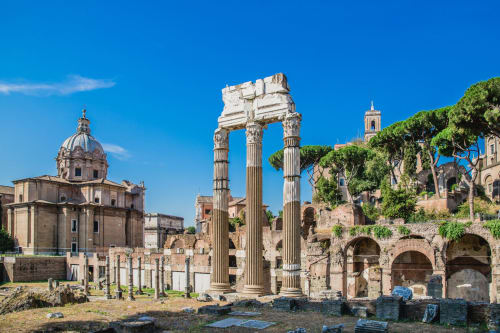
Fori Imperiali
The Fori Imperiali, located between the Colosseum and Piazza Venezia, represents the Ancient Roman Empire, the main place of public and private life.
The entrance, located on Via dei Fori Imperiali, and take you to start your tour starting from the ruins of the Temple of Caesar, which is reached after Piazza del Foro, an ancient center of town life, whose center is the Column of Phocas. Work can be seen near the remains of Septimius Severus, the Temple of Concordia, one of Vespasian and that of Saturn.
There are also worth visiting: the Temple of Augustus, the Basilica of Constantine, the remains of the Church of Santa Maria Antiqua, the House of the Vestal Virgins, the Church of Santa Francesca Romana, the Arch of Titus, the Farnese Gardens, the House of Augustus, the House Augustana, Domus Flavia Stadium and Palatine.
The entrance, located on Via dei Fori Imperiali, and take you to start your tour starting from the ruins of the Temple of Caesar, which is reached after Piazza del Foro, an ancient center of town life, whose center is the Column of Phocas. Work can be seen near the remains of Septimius Severus, the Temple of Concordia, one of Vespasian and that of Saturn.
There are also worth visiting: the Temple of Augustus, the Basilica of Constantine, the remains of the Church of Santa Maria Antiqua, the House of the Vestal Virgins, the Church of Santa Francesca Romana, the Arch of Titus, the Farnese Gardens, the House of Augustus, the House Augustana, Domus Flavia Stadium and Palatine.